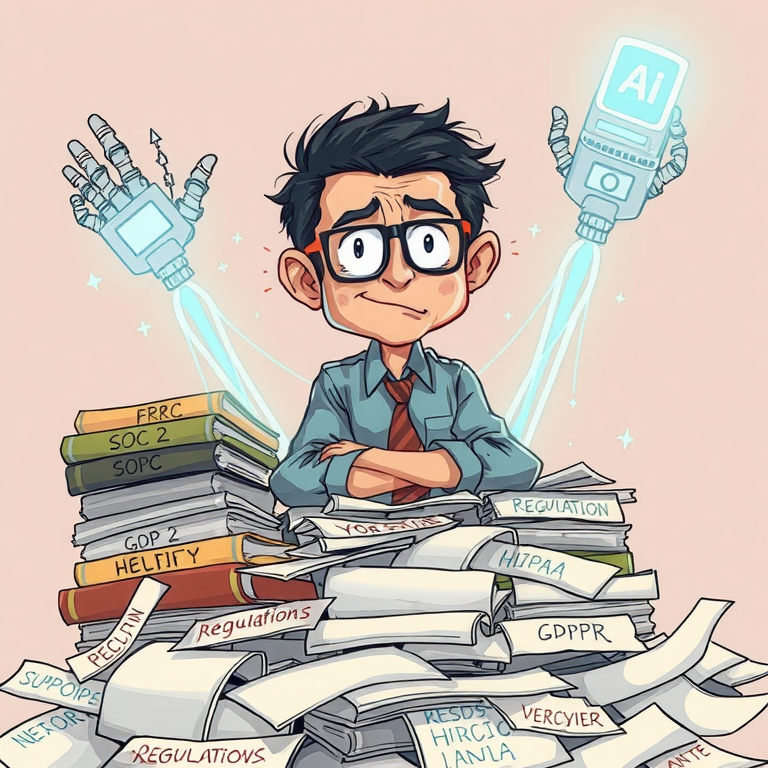

Governance, risk, and compliance (GRC) is at a crossroads. As organizations grow and regulatory landscapes evolve, traditional methods struggle to keep pace. Facing the increasing complexity AI is no longer a luxury—it’s becoming a necessity for modern GRC professionals.
The Scale and Complexity of Modern GRC
Today’s global environment means that even mid‑size firms must navigate dozens of control frameworks—SOC 2, ISO 27001, HITRUST, FedRAMP, GDPR, HIPAA, and more. Large enterprises face an exponential explosion of overlapping requirements, region‑specific regulations, diverse product lines, and the constant need for continuous monitoring.
Existing GRC tools excel at cataloguing policies, control objectives, evidence, and similar artifacts. They offer sophisticated process management and first‑order analytics (e.g., counting controls, tracking evidence collection, cost per control, audit overlaps). However, as business complexity rises, the second‑order analytics—such as determining gaps against a specific framework, optimizing control scope, or assessing whether a risk management system is truly effective—still rely heavily on manual subject‑matter‑expert (SME) involvement. These insights often arrive too late or are already outdated when delivered, and scaling linearly with business growth is simply unsustainable.
Where AI Fits In
AI’s unique capacity to process and analyze vast amounts of data makes it the ideal tool to bridge these gaps. Below are key reasons why AI assistance is becoming a necessity in the GRC space:
- Speed and Efficiency. AI can evaluate frameworks, identify gaps, and suggest solutions far faster than a human team. For example, introducing a regulation like DORA might traditionally require months of effort; with AI, mapping requirements, identifying gaps, and drafting project plans can often be completed in days.
- Scalability. Unlike human teams, AI scales effortlessly. Whether you’re dealing with one framework or twenty, AI tools adapt to volume and complexity without additional resources.
- Continuous Monitoring. Traditional assurance methods rely on periodic audits, providing only snapshots that are often reactive. AI enables continuous monitoring at a lower cost and greater coverage, ensuring organizations stay compliant as their environments change. This real‑time approach also allows “what if?” analyses, making risk management more proactive.
- Customization and Context. Risk is inherently contextual; no two organizations are identical. AI can factor in unique policies, controls, and processes to deliver tailored recommendations that surpass generic insights from conventional tools.
The Evolving Role of GRC Professionals
AI does not replace GRC experts—it acts as an assistant that amplifies their work. By automating repetitive tasks and delivering actionable insights, AI frees professionals to focus on strategic initiatives: optimizing risk processes, preparing for emerging challenges, and steering the organization toward a resilient compliance posture. For instance, AI can perform pre‑audit scans to surface potential issues, allowing GRC teams to tackle only the most complex problems. This collaboration yields the best outcomes.
The Future of AI‑Assisted GRC
Security organizations face dual pressures: an ever‑increasing number of regulations worldwide and more sophisticated adversaries. Their GRC capabilities must evolve both quantitatively and qualitatively. AI assistance is central to that evolution.
At Trustero, we are pioneering this shift by leveraging AI to simplify GRC processes and empower organizations to navigate the evolving regulatory landscape with confidence. By combining AI’s capabilities with human expertise, we’re shaping a future where security and compliance are not just achievable but also efficient, scalable, and resilient.
Bottom Line
AI is no longer optional in GRC—it’s essential. The real question is not whether to adopt AI, but how soon you can start leveraging its potential to transform your compliance efforts. The era of manual, reactive compliance is over; welcome to the era of AI‑driven, proactive GRC.