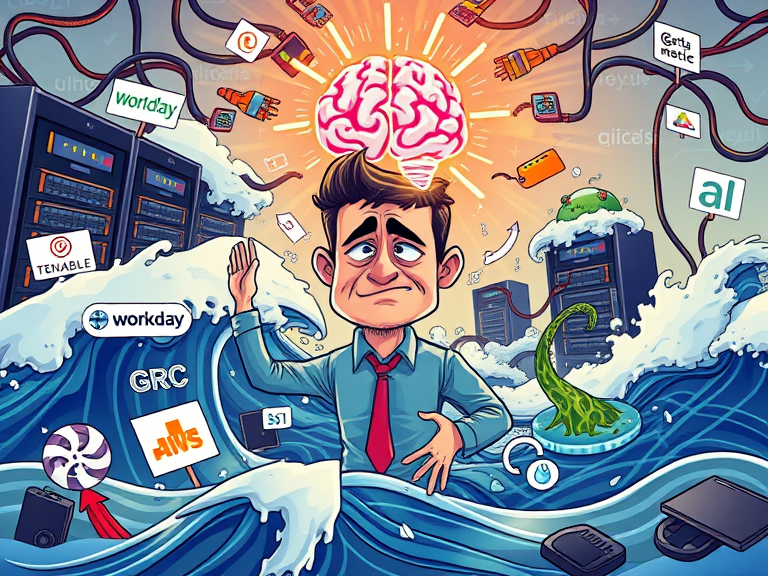

For years, organizations have wrestled with the challenge of unified visibility across Governance, Risk, and Compliance (GRC). The problem isn't a lack of data, it’s the abundance of it, scattered across a growing landscape of specialized systems. HR policies reside in Workday, configuration data in a CMDB, evidence in Tenable, and controls in a dedicated GRC tool – each a “source of truth” managed by the function best equipped to handle it.
This distributed architecture is smart - the data is managed closer to the team responsible for it. But it creates a system integration nightmare. Constant mapping, data transformation, and synchronization efforts are required to feed analytics, monitor compliance, and even just understand the overall risk posture. It’s a never-ending cycle of custom scripts, brittle integrations, and manual reconciliation.
The common solution? The Data Lake. The promise is simple: ingest everything, then analyze. However, quickly, the data lake morphs into a data swamp. Different teams require different data views, leading to duplicated data, complex transformations within the lake, and a maintenance burden that rivals the initial integration challenge. The lake, ironically, becomes a new silo – a complex, costly, and often unusable one.
What if you could bypass the swamp altogether?
We believe the answer lies in an intelligent abstraction layer, powered by AI. Instead of syncing the data, we connect to the sources of truth and let AI handle the heavy lifting of understanding and relating it. Think of it as a semantic, self organizing abstraction layer, built and maintained by artificial intelligence.
How does it work in the GRC world?
Imagine your AI-powered GRC system. You don't sync policies from HR into a central repository. Instead, you point the system to the HR system. You do the same for your CMDB (configuration management database), your vulnerability scanners (Tenable, Qualys), and your existing GRC tools that hold controls and evidence.
Our patented "Trust Graph" technology builds and maintains the semantic links between these disparate artifacts. The AI understands that a specific HR policy relates to a particular security control, which in turn is validated by evidence collected from your AWS environment. It's not just about syncing and transforming data; it's about relationships.
This means you get a single pane of glass for monitoring and analytics without the agonizing process of ETL (Extract, Transform, Load). You don't need to worry about data synchronization or building complex data pipelines. The AI automatically handles it.
The Benefits are Clear:
- Rapid Adoption: Connect to existing systems, no lengthy data migration required.
- Low Maintenance: Forget about customized scripts and constant data syncing. The AI keeps everything aligned.
- Eliminate Mapping & Transformation: The AI understands the context of the data, removing the need for manual mapping.
- AI-Powered Analytics: Unlock deeper insights with contextualized data. Ask “What controls are affected by this new HR policy?” and get a clear, comprehensive answer.
Stop drowning in data and start leveraging the power of AI to transform your GRC. It's time to move towards a truly unified and intelligent GRC solution.