Your GRC Tasks. Automated. Repeatable.
More Consistent Work. More Capacity. Less Guesswork.
Using natural language to describe a repeatable GRC task and handing it off to a team of AI agents changes what your program can accomplish.
Higher Quality, Every Time
Remove the inconsistencies. Every playbook run follows the same workflow and produces the same caliber of output — regardless of who runs it.
Reduce Tribal Knowledge
When GRC work lives inside playbooks, it belongs to the team — not any one individual. Onboard new members faster and keep critical workflows running through any transition.
Do More With the Same Team
Playbooks give your team the leverage to catch up on routine work and stay ahead. Workflows that used to take days run in the background while your team focuses on high value work, not chasing data and performing mundane tasks.
Free Resources for High-Value Work
Offloading repeatable workflows to AI agents means your team spends less time on routine tasks and more time on the work that requires human judgment.
HOW IT WORKS
Describe It. Run It. Schedule It.
Think of a TI Playbook as a brief to a new member of your team on how to accomplish a task. You describe the workflow they need to follow, and a team of expert AI agents — already contextualized with your GRC data — carries it out.
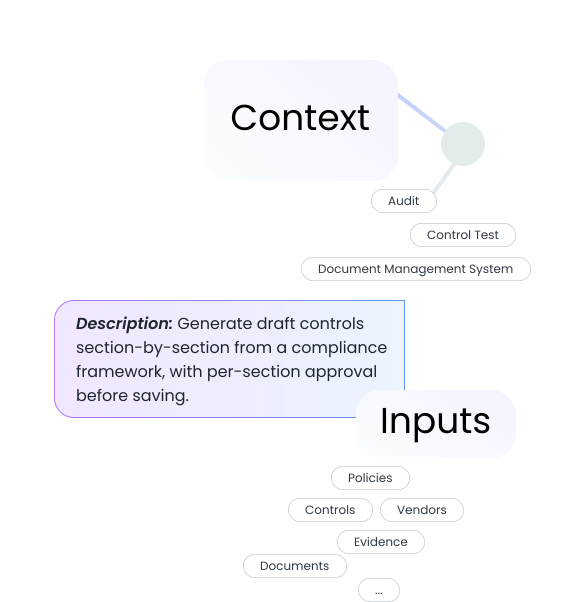
Setting up a playbook involves three steps. First, specify the context: use everything available, or focus on a specific content type — your policies, controls, knowledgebase. Second, describe the workflow in plain language. The playbook could interact with you mid-run to collect additional information or confirm a choice. Third, define the delivery — a report added to the reports library, for example.
Behind the scenes, Trustero's multi-agent architecture builds a plan, engages the right specialized agents, performs semantic search and mapping, generates documents, and summarizes information from across your GRC program. Every result includes reasoning and cited references — exactly what you'd expect from a great analyst.
BUILT-IN AND CUSTOM PLAYBOOKS
Start Fast. Make It Yours.
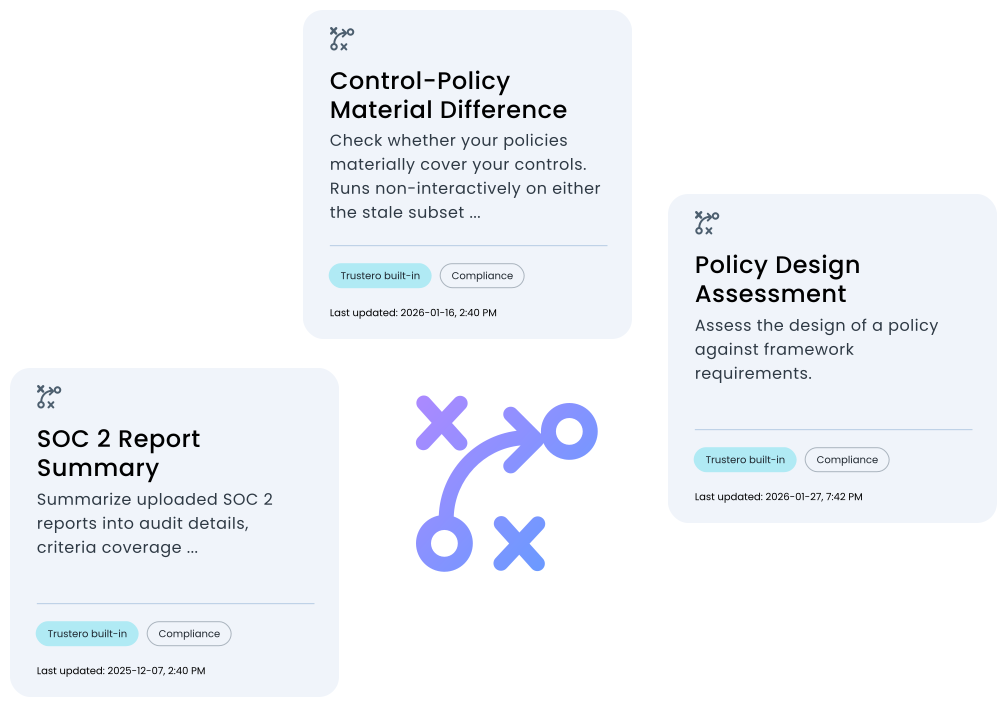
Trustero ships with a library of built-in playbooks for the most common GRC workflows — so your team can get off the ground immediately. As your program evolves, build custom playbooks that reflect how your organization specifics: your intricacies, your reporting cadences, your internal standards, and your specific workflows.
Built-in playbooks cover tasks like:
- Executive risk report with a summary of top risks by severity and business area, surfacing key trends, ownership, and risk concentrations.
- Organizational User Access Review, based on policies, organizational chart, and user and employee lists
- Policy Design Assessments against a new framework with gaps and recommendations
- Generate controls against a new framework, considering your current state
Custom playbooks let you go further — tailoring the context, workflow, and output to exactly what your program requires.
.svg)
How GRC Leaders Use TI Playbooks Every Day
Scenario:
A compliance program manager needs a weekly view of control performance across all active frameworks — with the top ten control owners flagged for issues, broken down by department, and corrective action recommendations attached. Previously, assembling this report meant hours of manual data collection across systems. With a scheduled TI Playbook, it runs every Monday morning and lands in the reports library, ready to review and distribute.
Scenario:
User Access Reviews are a non-negotiable part of most compliance programs — and a consistently time-consuming one. A compliance manager sets up a monthly TI Playbook that pulls the relevant access data for each system, the up-to-date org chart and employees list, identifies issues against defined policy criteria, and produces a structured report with findings documented and ready for remediation tracking.
Scenario:
A GRC analyst needs to assess whether existing control test procedures are adequate given the evidence currently on hand. The team sets up a playbook that reviews all test procedures, evaluates them against the available evidence and control objectives, and produces a prioritized list of improvements — highlighting where procedures are weak, missing coverage, or misaligned with what evidence is being collected.
Scenario:
A TPRM Analyst receives a stack of vendor credentials — SOC 2 reports, security questionnaires, penetration test results — that need to be reviewed before a vendor can be onboarded or renewed. Instead of assigning a team member days to read and summarize each document, they run a TI Playbook. The playbook examines the credentials, highlights potential issues, and recommends remediations or compensating controls where gaps are found.
Scenario:
The company is expanding in a new market and the GRC team needs to quickly evaluate whether to adopt a new compliance framework. Instead of spending weeks reviewing the new requirements and mapping them against their environment, they run a Policy Design Assessment playbook against the framework. The playbook performs a semantic comparison of existing policies against the new framework's requirements, explains the gaps in plain language, and proposes remediations — giving leadership a clear picture of the effort involved before any work begins.
Scenario:
A new version of an already adopted framework has been published. The GRC team needs to determine which controls must be updated and new controls to be added.Rather than spending weeks mapping new to old controls, they run a TI Playbook that analyzes their existing controls and evidence, identifies what already applies to the new framework's requirements, and generates a set of tailored controls to close what's missing — giving the team a strong starting point for the expansion.