The First Multi-Agent AI Built for GRC
Multi-agent AI for GRC uses specialized AI agents to execute governance, risk, compliance, audit, and assessment work across connected systems. Trustero AI makes those workflows continuous, source-backed, and traceable through the Trust Graph.
p95 accuracy of 97.5%
340% average ROI in 12 months
65% reduction in audit prep time
Trusted by enterprise security and compliance teams
GRC Has Hit a Structural Breaking Point
The rules governing your business have multiplied by more than 500% since 2008. Your technology stack has grown more complex. Your vendor ecosystem now exposes you to thousands of fourth- and fifth-party risks. And your customers expect real-time compliance transparency — not an annual attestation.
Yet most GRC teams are still running the same manual processes they used a decade ago. Spreadsheets. Email chains. Quarterly control tests. Eight-week audit sprints.
This isn't a staffing problem. Hiring more people won't solve it. It's a systems problem — and the only viable solution is a fundamentally different operating model.
The core problem is that GRC work scales with every new framework, vendor, system, policy, and customer request. Without automation that can actually execute work, compliance teams remain trapped in a headcount-dependent model that cannot keep pace.
500%+
Increase in global regulatory changes since 2008 (Thomson Reuters)
$14.82M
Average cost of non-compliance — 2.71× the cost of compliance (Ponemon Institute)
35.5%
Of all 2024 data breaches originated from third-party vendors (SecurityScorecard)
Multi-Agent AI for GRC: What It Is and Why It Changes Everything
Multi-agent AI is a coordinated system of specialized AI agents that reason, decide, and act autonomously to accomplish complex, multi-step objectives. Unlike a general chatbot — which responds to prompts — or a traditional GRC SaaS platform — which organizes human work — a multi-agent GRC system executes GRC functions directly.
Each agent is purpose-built for a specific task: testing controls, scoring vendor risk, closing policy gaps, managing evidence. Agents share context, coordinate across workflows, and operate continuously — without headcount constraints and without degrading at scale.
That distinction matters because GRC teams do not only need faster drafting. They need systems that can read evidence, evaluate controls, map requirements, score risk, generate findings, and preserve an audit trail without forcing humans to coordinate every step manually.
"GRC SaaS tells you what needs to be done. AI chatbots help you draft a response. Multi-agent GRC does the work."

A GRC Intelligence Layer, Not Another Tool
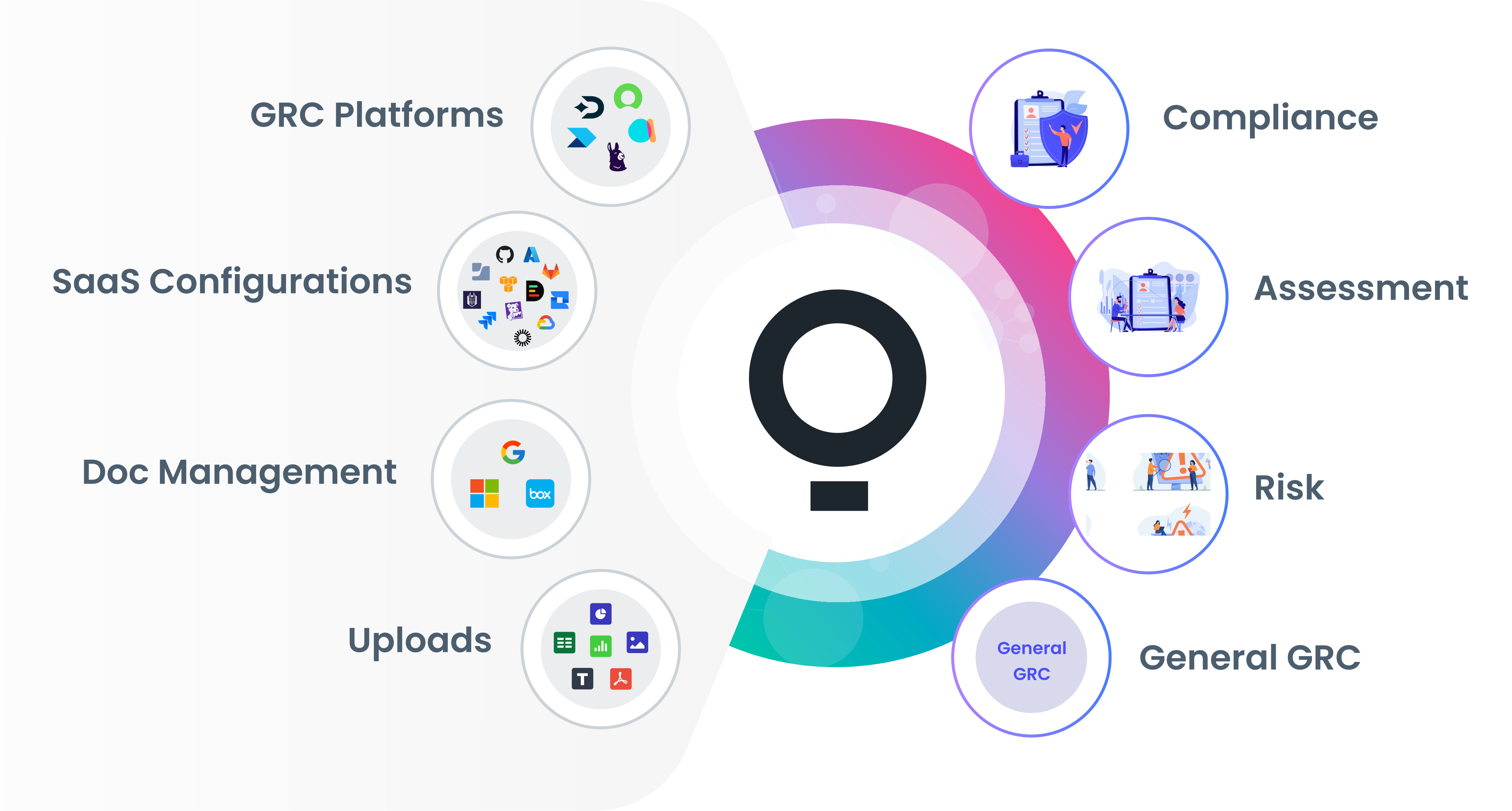
Trustero AI is the first enterprise-grade multi-agent AI purpose-built for Governance, Risk, and Compliance. It is not a general AI tool adapted for GRC. It is not a traditional GRC platform with AI bolted on. It is a dedicated GRC intelligence layer that sits alongside your existing infrastructure — ingesting data, enriching it, and executing compliance work across your organization continuously.
At the core of Trustero AI is the Trust Graph: a continuously enriched knowledge structure that ingests GRC-relevant data from SaaS applications, on-premises systems, shared drives, and existing GRC platforms. Trustero's agents operate within a constrained Trust Graph context — ensuring every output is accurate, consistent, and directly traceable to source data.
This architecture is what makes Trustero AI enterprise-grade. Not just capable. Compliant-by-design.
The Trust Graph gives each AI agent governed context for the task it is performing, so outputs are grounded in approved policies, controls, evidence, frameworks, owners, and system data instead of unsupported general responses.
Four Domains. Continuous Execution. Zero Manual Overhead.
Trustero AI agents operate across four functional domains — each replacing a category of high-volume, low-judgment GRC work that currently consumes your team's capacity.
Because each domain works from a shared Trust Graph context, Trustero AI can connect evidence, controls, policies, risks, vendors, and answers across workflows instead of treating each GRC task as a disconnected project.
Always-On Control Monitoring
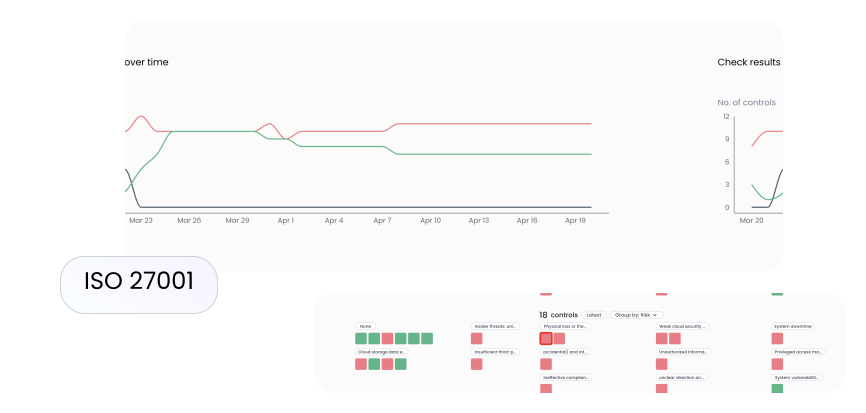
Trustero compliance agents continuously execute control test procedures written in natural language, producing auditable pass/fail determinations for every control. They generate code dynamically for deterministic tests on structured evidence, and intelligently join evidence from disparate data sources by identifying semantically similar columns.
What this replaces: Quarterly manual control testing. 2,400+ hours per framework per year. What you gain: Real-time compliance posture. Audit-ready at any moment
This turns control testing from a periodic audit sprint into an always-on control monitoring workflow with evidence-backed results your team can review and remediate.
.avif)
Policy Gap Analysis and Regulatory Mapping — at Scale
Trustero assessment agents semantically compare your policies against any regulatory requirement or compliance framework. They extract requirements from any specification document, evaluate your full control library, and surface gaps — in hours, not weeks.
What this replaces: Consultant-led gap assessments. Months-long review cycles. What you gain: Continuous gap identification. Immediate remediation pathways.
Assessment agents help teams see where policy language, control design, and framework requirements diverge before those gaps become audit findings or remediation fire drills.
Automated Vendor Risk and Questionnaire Intelligence
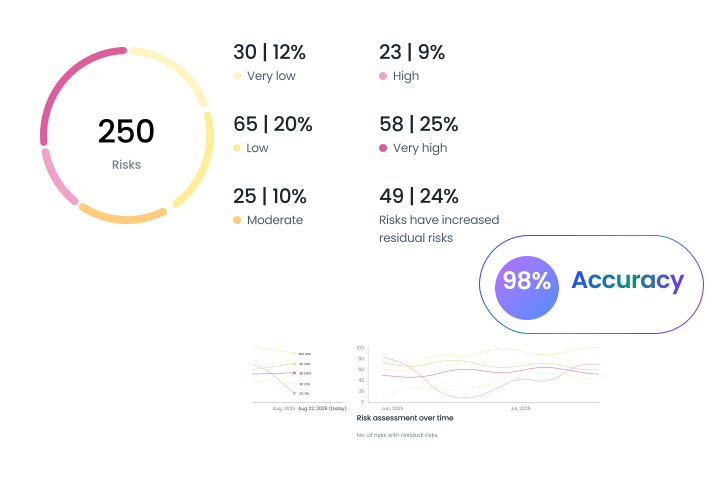
Trustero risk agents automatically answer complex security questionnaires and RFIs using your GRC Knowledge Base. They assess vendor risk profiles by gathering and analyzing attestations against your corporate requirements, and compute residual risk scores factoring in control effectiveness and other mitigation data.
What this replaces: Weeks-long manual vendor review cycles. One TPRM professional managing 33+ vendors manually. What you gain: Risk identified and scored before exposure occurs.
Risk agents reduce manual third-party review work by connecting questionnaire responses, attestations, control effectiveness, and residual risk into one evidence-backed assessment flow.
Access Reviews, Risk Forecasting, and Cross-Org Compliance
Trustero general GRC agents conduct user access reviews aligned to organizational policy, forecast risk posture changes before they become incidents, and identify coverage gaps across your risk register. Any employee — in engineering, procurement, finance, or HR — can ask GRC questions and receive authoritative, grounded answers instantly.
What this replaces: GRC team as the permanent organizational bottleneck. What you gain: Compliance embedded in every team's workflow. Friction eliminated at the source.
The Difference Is Architectural
Not Incremental
| Capability | Traditional GRC SaaS | General AI Chatbots | Trustero AI |
|---|---|---|---|
| Core function | Organizes human work | Responds to prompts | Executes GRC tasks autonomously |
| Scalability | Linear with headcount | No GRC specialization | Near-infinite capacity |
| Audit trail | Manual documentation | None | Built-in, traceable, auditable |
| Cross-org reach | GRC team only | No workflow integration | Embedded across the organization |
| Adapts to change | Requires manual update | Requires re-prompting | Ingests and reacts automatically |
For buyers comparing AI for GRC, the key question is not whether the system can produce text. It is whether the system can execute GRC workflows, preserve source traceability, adapt as data changes, and operate within governed enterprise context.
From Manual to Multi-Agent: What the Shift Looks Like
| GRC Function | Before Trustero AI | With Trustero AI | Business Outcome |
|---|---|---|---|
| Control Monitoring | Quarterly manual testing | Always-on automated testing | Real-time posture, audit-ready always |
| Vendor Risk Assessment | Manual review (weeks per vendor) | Automated attestation analysis (hours) | Risk scored before exposure occurs |
| Policy Gap Analysis | Consultant-led reviews | Agent-led semantic comparison | Faster cycles, immediate gap identification |
| Evidence Management | Email and spreadsheet chaos | Automated ingestion, mapping, enrichment | Audit readiness on demand |
| Cross-Org Compliance | GRC team as bottleneck | Compliance in every team's workflow | Friction eliminated at the source |
The shift is from humans coordinating every GRC task to AI agents executing repeatable workflows while humans review exceptions, strategy, and decisions that require judgment.
The Business Case for Multi-Agent GRC Is Not Speculative
The financial consequences of staying manual are documented and growing. Non-compliance costs organizations an average of $14.82 million — 2.71 times the cost of proactive compliance investment. Third-party breaches average $4.91 million each and take 267 days to identify and contain. Meanwhile, manual GRC processes consume more than 2,400 hours per compliance framework annually.
Organizations that have deployed multi-agent GRC automation report:
IBM's 2025 Cost of a Data Breach report confirms that organizations with extensive AI and automation saved an average of $1.9 million per breach compared to those without — and identified breaches 80 days faster.
The question is not whether the ROI is positive. It is how long your organization can afford to delay.
(Sources: Axis Intelligence 2025, IBM Cost of a Data Breach Report 2025, Ponemon Institute / Globalscape)
The ROI compounds because GRC work repeats across frameworks, audits, controls, vendors, questionnaires, and internal reviews. Automating those recurring workflows reduces effort every cycle, not just during a one-time implementation.

Extend the Intelligence Layer as Your Business Evolves
Trustero AI is not a fixed product. It is an extensible system. Using Trustero Playbooks — prompt-based agent creation tools built directly into the system — your team can create new specialized agents that work alongside all existing Trustero AI agents.
As regulations change, as your business expands into new jurisdictions, as your risk profile shifts, Trustero AI adapts. Not through software updates you wait for. Through agents your team configures and deploys.
Your compliance requirements will keep changing. Your GRC intelligence layer should keep up.
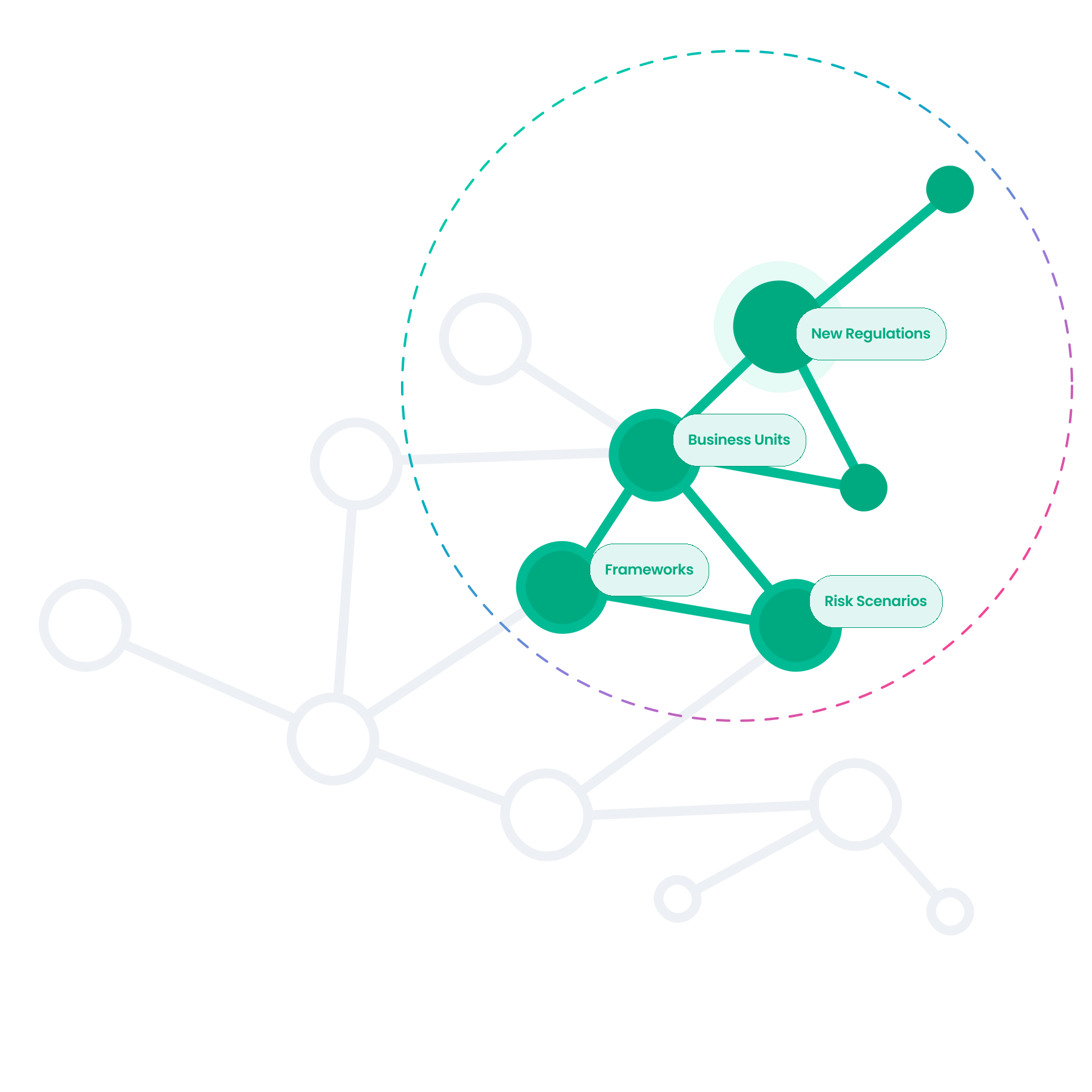
Trustero Playbooks let teams turn recurring GRC work into reusable AI-agent workflows that can evolve with new regulations, business units, frameworks, and risk scenarios.
GRC Has Hit a Structural Breaking Point
The rules governing your business have multiplied by more than 500% since 2008. Your technology stack has grown more complex. Your vendor ecosystem now exposes you to thousands of fourth- and fifth-party risks. And your customers expect real-time compliance transparency — not an annual attestation.
Yet most GRC teams are still running the same manual processes they used a decade ago. Spreadsheets. Email chains. Quarterly control tests. Eight-week audit sprints.
This isn't a staffing problem. Hiring more people won't solve it. It's a systems problem — and the only viable solution is a fundamentally different operating model.
Multi-Agent AI for GRC: What It Is and Why It Changes Everything
Multi-agent AI is a coordinated system of specialized AI agents that reason, decide, and act autonomously to accomplish complex, multi-step objectives. Unlike a general chatbot — which responds to prompts — or a traditional GRC SaaS platform — which organizes human work — a multi-agent GRC system executes GRC functions directly.
Each agent is purpose-built for a specific task: testing controls, scoring vendor risk, closing policy gaps, managing evidence. Agents share context, coordinate across workflows, and operate continuously — without headcount constraints and without degrading at scale.
GRC is uniquely suited to this model. Compliance work is rules-based, repetitive, high-volume, and audit-sensitive. These are precisely the conditions where specialized AI agents deliver the most value. And because GRC obligations span every team in your organization — not just the compliance function — a system that embeds compliance intelligence across the entire business changes what's possible.
A GRC Intelligence Layer, Not Another Tool
Trustero AI is the first enterprise-grade multi-agent AI platform purpose-built for Governance, Risk, and Compliance. It is not a general AI tool adapted for GRC. It is not a traditional GRC platform with AI bolted on. It is a dedicated GRC intelligence layer that sits alongside your existing infrastructure — ingesting data, enriching it, and executing compliance work across your organization continuously.
At the core of Trustero AI is the Trust Graph: a continuously enriched knowledge structure that ingests GRC-relevant data from SaaS applications, on-premises systems, shared drives, and existing GRC platforms. Trustero's agents operate within constrained Trust Graph context — ensuring every output is accurate, consistent, and directly traceable to source data.
This architecture is what makes Trustero AI enterprise-grade. Not just capable. Compliant-by-design.
The Organizations That Act Now Will Set the Standard
See What Multi-Agent GRC Looks Like in Your Environment Trustero AI works directly with enterprise security and compliance leaders to assess current GRC capacity gaps, map implementation pathways, and demonstrate measurable ROI within the first few months.
Frequently Asked Questions About Multi-Agent AI for GRC
Multi-agent AI for GRC is a system of specialized AI agents that autonomously execute governance, risk, and compliance functions — including control testing, vendor risk assessment, policy gap analysis, and evidence management. Unlike traditional GRC software or general AI chatbots, multi-agent GRC do the work rather than organizing or assisting with human-led processes.
Traditional GRC SaaS platforms organize and manage human work — they prompt people to complete compliance tasks but do not execute those tasks themselves. Trustero AI replaces manual execution with autonomous AI agents that continuously perform GRC functions with auditable accuracy, reducing the need for headcount-dependent scaling.
Trustero AI agents performing control operational effectiveness checks achieve a p95 accuracy of 97.5% and a p90 consistency of 92% in benchmark testing. These figures reflect performance on real GRC data under production conditions.
Yes. Trustero AI is designed to layer into existing GRC infrastructure — ingesting data from SaaS platforms, on-premises systems, shared drives, and existing GRC tools. It extends your current compliance program rather than requiring you to replace functioning systems.
Organizations deploying multi-agent GRC automation have documented an average 340% ROI within 12 months, driven by labor cost reduction ($1.8M+), operational efficiency gains ($850K), and compliance cost avoidance ($2.1M). Audit preparation time decreases by an average of 65%.
Trustero AI agents operate across four domains: Compliance (continuous control monitoring and evidence management), Assessment (policy gap analysis and regulatory mapping), Risk (vendor risk assessment, questionnaire automation, residual risk scoring), and General GRC (user access reviews, risk forecasting, cross-organizational compliance enablement).
Yes. Trustero AI's distributed multi-agent architecture is inherently more secure than monolithic systems. Each agent operates on a narrower task with more restrictive data access, reducing the attack surface of any single component. Dedicated security agents monitor and restrict the behavior of other agents in real time.
AI-powered GRC automation uses artificial intelligence to execute governance, risk, compliance, audit, and assessment workflows that would otherwise require manual effort. Trustero AI uses specialized agents to monitor controls, manage evidence, assess policies, answer questionnaires, score vendor risk, and preserve source-backed audit trails.
AI agents for compliance are specialized AI systems designed to complete specific compliance tasks, such as testing controls, mapping evidence, identifying policy gaps, or generating audit-ready responses. Trustero AI agents operate within governed Trust Graph context so their outputs are accurate, consistent, and traceable to source data.
Trust Graph traceability matters because GRC teams need to know which policies, controls, evidence, frameworks, and systems support every AI-generated answer or finding. Traceability helps reviewers validate outputs, explain decisions to auditors, and keep AI-generated work aligned with approved organizational context.