Automated Compliance Evidence Management — From Collection to Control, Powered by AI
.avif)

The Compliance Evidence Problem No One Has Fully Solved — Until Now
Evidence management is the hidden cost center of every GRC program. Your team is spread across 10, 15, even 19 different evidence repositories. Evidence lives in SharePoint, Google Drive, Confluence, Jira — and no two folders are organized the same way.
Every audit cycle, the same painful process begins:
Manually hunting down evidence from system owners
Copy-pasting files into your GRC tool one at a time
Spending hours figuring out which piece of evidence maps to which control
Hoping nothing falls through the cracks before the auditor arrives
The result:
Compliance teams burning hundreds of hours per audit on work that should be automated. The risk: gaps, delays, and findings that could have been prevented.
Trustero Evidence Management: The Intelligent GRC Evidence Platform
Trustero is the only GRC platform that combines automated evidence collection, repository synchronization, and AI-powered evidence-to-control mapping in a single, unified system.
We don't just store your evidence. We make it work.
FEATURE PILLARS
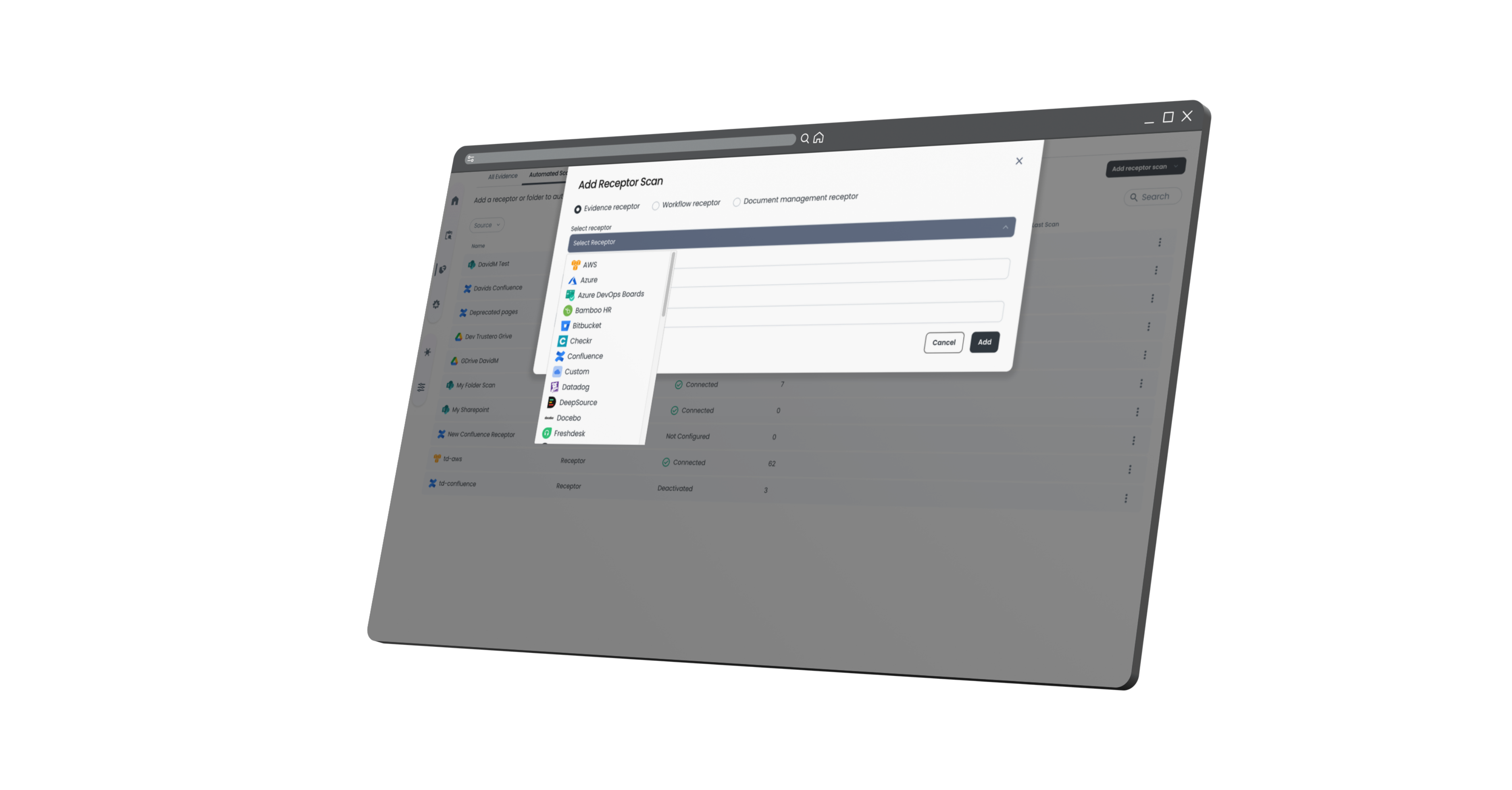
Automated Evidence Collection at Scale
Connect Trustero directly to your tech stack — cloud infrastructure, identity providers, HR systems, security tools, and more. Our evidence receptors automatically pull the data you need for every control, on a continuous basis.
What this means for your team:
- Real-time, always-current evidence from your live systems
- No more manual screenshots or export-and-upload workflows
- Evidence versioned and timestamped automatically — always audit-ready
- Full version history so you see exactly what your environment looked like on any audit date
"Every version of evidence collected over time is stored and scoped to your exact audit date range — so auditors see what was true then, not just what's true now."
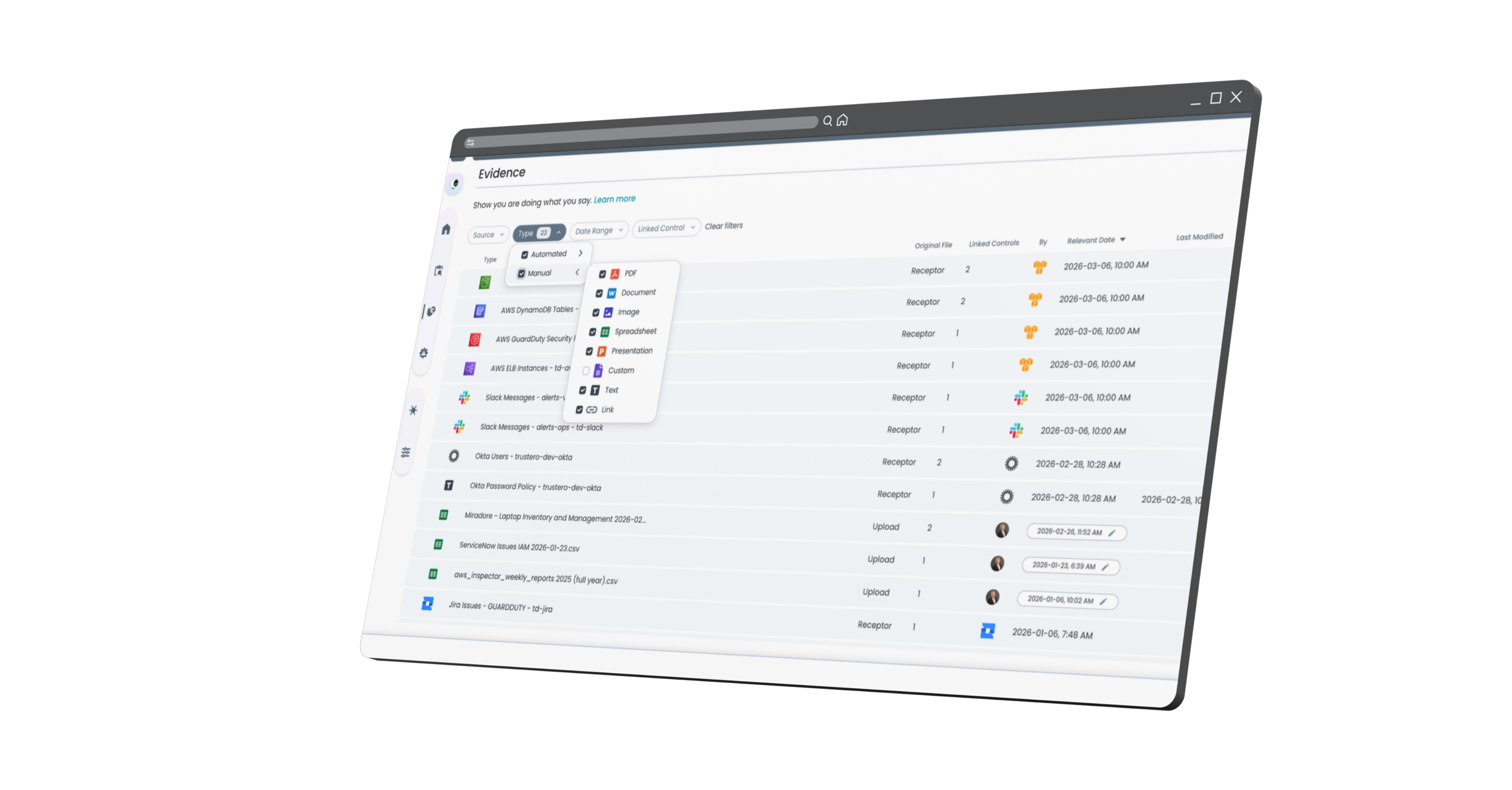
Repository Synchronization — Connect Evidence Where It Already Lives
Most GRC tools force you to copy evidence into their system. Trustero synchronizes with your existing evidence repositories instead.
Point Trustero at any SharePoint library, Google Drive folder, Confluence space, or file directory. We scan, import, and continuously sync your evidence — entire folder structures, not just individual files.
Built for enterprises with complex evidence ecosystems:
- Connect and sync dozens of separate evidence repositories simultaneously
- Automatic folder-level scanning and ingestion — no file-by-file uploads
- Evidence linked back to its source, always traceable
This is purpose-built for organizations where evidence is distributed across multiple teams, systems, and departments.
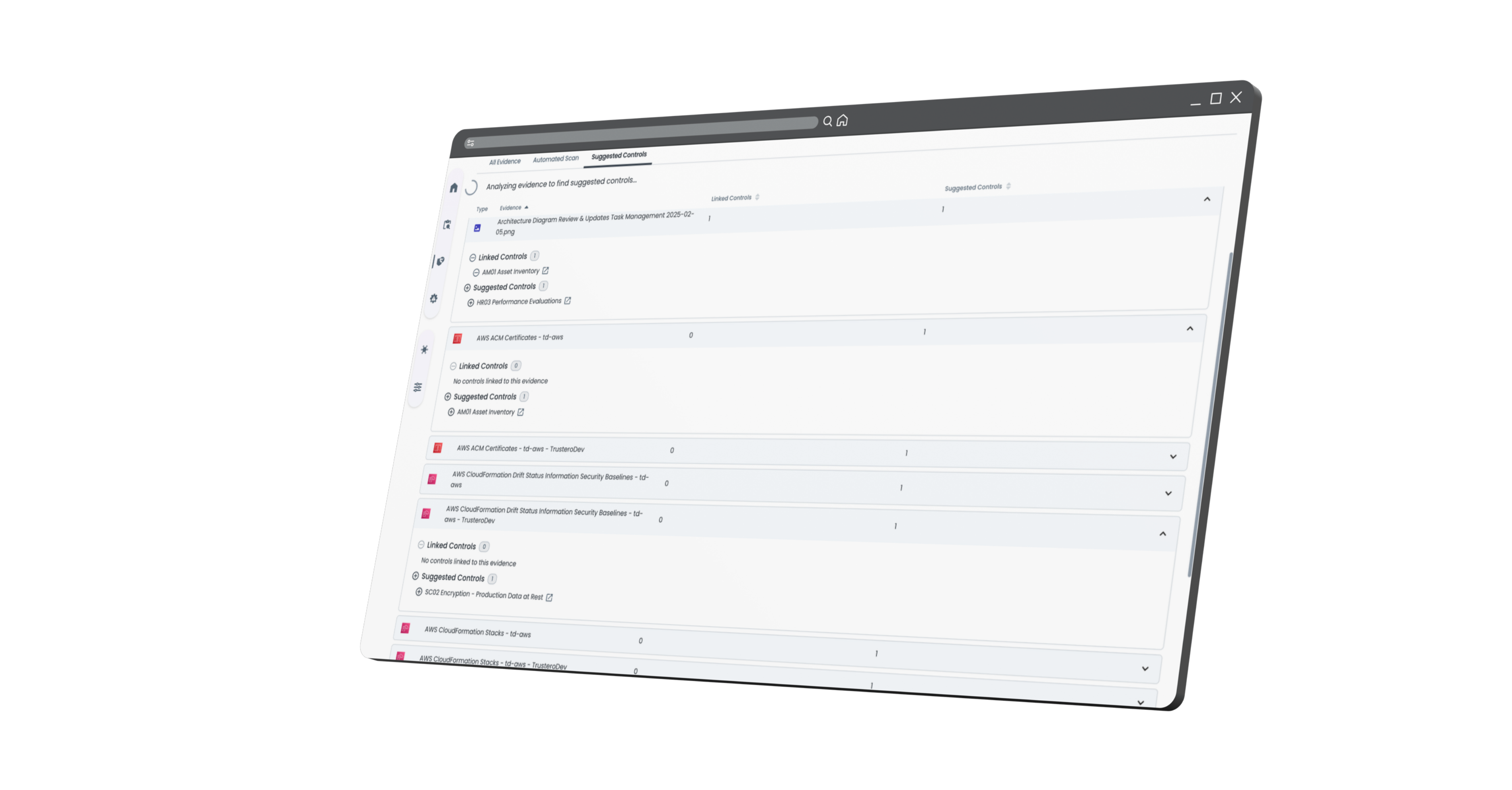
AI-Powered Evidence-to-Control Mapping
Collecting evidence is only half the problem. Routing it correctly is where most GRC teams lose hours.
Trustero uses AI to analyze every piece of evidence imported into the system and automatically recommend which controls it maps to — across any framework (SOC 2, ISO 27001, NIST, HIPAA, and more).
The result:
- Dramatically faster evidence review cycles
- Fewer mapping errors and audit findings
- AI recommendations your team reviews and approves — not a black box
No other GRC platform routes evidence to controls with this level of AI intelligence. Compliance teams using legacy tools like Archer or MetricStream do this entirely by hand.
Trustero Intelligence Copilot — Query, Correlate, and Analyze Your Evidence with AI
Your evidence is only as valuable as your ability to interrogate it.
The Trustero Intelligence (TI) Copilot is embedded directly into your evidence workspace. Ask it anything. It knows what you're looking at.
What you can do with TI Copilot:
Example: Automate your quarterly user access review — TI pulls data from every connected system, cross-references access levels, and generates a consolidated report. No spreadsheets. No manual reconciliation.

The Difference Is Architectural — Not Incremental
| Capability | Trustero AI | Others |
|---|---|---|
| Automated evidence collection |  | |
| Repository sync (folder-level) | |  |
| AI evidence-to-control mapping | | |
| Full evidence version history | | |
| NL Copilot / evidence query | | |
| Scheduled AI playbooks | | |
| Audit-date-scoped evidence view | | |
The Business Case for Automated Evidence Management
For GRC Directors and CISOs building the case internally:
The status quo cost: Compliance teams at mid-market and enterprise companies spend an estimated 200–500 hours per audit cycle on manual evidence collection, mapping, and analysis. Multiplied across multiple frameworks and annual audits, this represents a significant and recurring operational burden — pulling senior compliance staff away from strategic risk work.
What Trustero AI changes:
- Continuous automated collection eliminates the pre-audit scramble
- AI-powered mapping cuts evidence review time by up to 80%
- Scheduled playbooks turn recurring manual reports (user access reviews, risk summaries) into zero-touch workflows
- Centralized evidence repository becomes a strategic asset — powering security questionnaires, audit readiness, and real-time risk visibility
The outcome: GRC teams that move from reactive, audit-driven compliance to continuous, automated compliance monitoring — with fewer FTEs and fewer findings.
Trusted by Compliance-Forward Organizations
Customer Spotlight: One enterprise financial services organization came to Trustero managing evidence across 19 separate repositories spread across multiple teams and systems. With Trustero's repository synchronization, they connected all 19 sources into a single, centrally managed evidence workspace — eliminating manual collection entirely.
GRC Has Hit a Structural Breaking Point
The rules governing your business have multiplied by more than 500% since 2008. Your technology stack has grown more complex. Your vendor ecosystem now exposes you to thousands of fourth- and fifth-party risks. And your customers expect real-time compliance transparency — not an annual attestation.
Yet most GRC teams are still running the same manual processes they used a decade ago. Spreadsheets. Email chains. Quarterly control tests. Eight-week audit sprints.
This isn't a staffing problem. Hiring more people won't solve it. It's a systems problem — and the only viable solution is a fundamentally different operating model.
Multi-Agent AI for GRC: What It Is and Why It Changes Everything
Multi-agent AI is a coordinated system of specialized AI agents that reason, decide, and act autonomously to accomplish complex, multi-step objectives. Unlike a general chatbot — which responds to prompts — or a traditional GRC SaaS platform — which organizes human work — a multi-agent GRC system executes GRC functions directly.
Each agent is purpose-built for a specific task: testing controls, scoring vendor risk, closing policy gaps, managing evidence. Agents share context, coordinate across workflows, and operate continuously — without headcount constraints and without degrading at scale.
GRC is uniquely suited to this model. Compliance work is rules-based, repetitive, high-volume, and audit-sensitive. These are precisely the conditions where specialized AI agents deliver the most value. And because GRC obligations span every team in your organization — not just the compliance function — a system that embeds compliance intelligence across the entire business changes what's possible.
A GRC Intelligence Layer, Not Another Tool
Trustero AI is the first enterprise-grade multi-agent AI platform purpose-built for Governance, Risk, and Compliance. It is not a general AI tool adapted for GRC. It is not a traditional GRC platform with AI bolted on. It is a dedicated GRC intelligence layer that sits alongside your existing infrastructure — ingesting data, enriching it, and executing compliance work across your organization continuously.
At the core of Trustero AI is the Trust Graph: a continuously enriched knowledge structure that ingests GRC-relevant data from SaaS applications, on-premises systems, shared drives, and existing GRC platforms. Trustero's agents operate within constrained Trust Graph context — ensuring every output is accurate, consistent, and directly traceable to source data.
This architecture is what makes Trustero AI enterprise-grade. Not just capable. Compliant-by-design.
Ready to Modernize Your GRC Evidence Program?
Whether you're preparing for SOC 2, ISO 27001, HIPAA, or a custom framework — Trustero AI gives your team the automated evidence management infrastructure to move faster, make fewer mistakes, and prove compliance continuously.
Frequently Asked Questions
Automated compliance evidence management is the process of using software to automatically collect, organize, store, and map evidence required for compliance audits — replacing manual uploads, copy-paste workflows, and spreadsheet-based tracking. Tools like Trustero connect directly to your tech stack and existing document repositories to continuously gather and route evidence to the appropriate controls.
AI enables compliance platforms to analyze incoming evidence and intelligently recommend which controls it should be mapped to — a process that traditionally requires hours of manual review. AI can also correlate multiple evidence sources, filter large datasets, perform row-by-row pass/fail analysis, and generate executive-ready reports automatically.
Evidence-to-control mapping is the process of linking a specific piece of compliance evidence (e.g., an access log, a configuration snapshot, a policy document) to the specific control it satisfies within a compliance framework such as SOC 2, ISO 27001, or NIST. Accurate mapping is required for audit validation. Trustero automates this mapping using AI analysis of both the evidence and the control requirements.
Yes. Trustero's repository synchronization feature connects directly to SharePoint, Google Drive, Confluence, and other document management systems. It scans folder structures and continuously syncs evidence — so compliance teams don't need to manually upload files into a separate GRC tool.
While platforms like Drata, Vanta, and Anecdotes offer automated evidence collection, Trustero is differentiated by its post-ingestion intelligence: AI-powered evidence-to-control mapping, full version history with audit-date scoping, repository synchronization at the folder level, and the Trustero Intelligence Copilot for natural-language evidence querying, correlation, and analysis. These capabilities are not available on competing platforms.
A Trustero Playbook is a reusable, schedulable AI workflow that automates a specific compliance task — such as generating a user access review report, producing an executive risk summary, correlating evidence across multiple sources, or filtering large tabular datasets. Playbooks can be run on demand or scheduled to execute automatically on a daily, weekly, or monthly basis.
Trustero — Automated Compliance, Continuous Assurance